Fortunately, brake pads are engineered to give clear indications when they need to be inspected and possibly replaced. Here are some ways to identify these signs.
Brake checks while driving
There are several methods to stay aware of your brakes’ condition and determine when they require attention.
Listen to your brakes
According to J.D. Power and Associates, brake pads are designed to emit a sound as an early warning that they need replacing. This noise typically resembles metal scraping against the wheels while the vehicle is in motion. The sound from these wear indicators usually becomes louder with increased brake use. If your brakes remain noisy after inspection, further adjustments or repairs might be necessary.
Pay attention to your brake pedal and steering wheel
Worn brake pads often cause vibrations in the brake pedal during braking. A vibrating steering wheel while braking can also indicate brake pad problems.
Watch for the warning light
If the brake warning light on your dashboard illuminates while driving, Cars.com advises that you might be low on brake fluid. It’s important to have your brakes checked promptly.
If you suspect any issues with your brake system, have it inspected by a professional without delay.
Inspecting brake pads without removing the wheels
It can be useful to visually check your brakes for obvious wear and tear. When the car is parked safely and the ignition is off, consider these tips for inspecting your brake pads:
Look at the wheels
MotorWeek notes that brake dust buildup on wheels is a common sign of normal wear. If your wheels appear dirtier or cleaner than usual, it may be wise to have your brakes examined.
Observe the brake pad
On many vehicles, the brake pad is visible through the wheel. Check its thickness; if it looks very thin, it might need inspection or replacement, according to J.D. Power. Some brake pads feature a slot in the centre serving as a wear indicator—if this slot is nearly gone, it’s time to think about replacing the pads.
Removing the wheels for a closer look
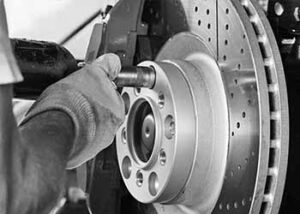
For an unobstructed view of your brakes, remove the wheels. You can follow steps similar to those used for changing a flat tyre to safely remove the wheel:
– Wedge the wheels
– Loosen the lug nuts
– Raise the car
– Remove the lug nuts and tyre
Once the wheel is off, you should clearly see the brake pads and check for excessive wear as described above. Note that removing wheels requires tools such as a jack and lug wrench.
When to replace brake pads
There isn’t a fixed timeframe or mileage for replacing brake pads, as it depends on your car and driving conditions. For instance, in urban environments, brake pads may last between 30,000 and 35,000 miles, while highway driving with less hard braking can extend their life to around 80,000 miles, says Bridgestone Tire.
As mentioned, you should watch and listen for signs indicating the need for replacement, including:
– Pulsation or vibrations in the brake pedal
– Longer stopping distances
– The brake pedal pressing down further than usual
– The vehicle pulling to one side when braking
– Visibly thin brake pads
– Squealing or clicking noises
Brake pads are generally designed to produce an unpleasant noise when worn. If you hear clicking, squealing, grinding, or screeching sounds when braking normally, it likely means the pads are worn and need replacing.
Pulsations or vibrations in the brake pedal
Strong vibrations or pulsations when braking usually indicate worn brake pads, according to Goodyear Brakes. However, this can also suggest rotor issues, so it’s important to investigate and fix the problem promptly.
Longer stopping distances
If your vehicle takes longer than normal to slow down, it could be due to deteriorated brake pads, says Firestone. As pads wear out, stopping distances tend to increase.
Deeper brake pedal press
If you find yourself pressing the brake pedal close to the floor to stop, your brake pads may be nearing the end of their life, according to Performance Honda. This could also point to other issues, so have your vehicle checked as soon as possible.
Braking causes vehicle drift
If the vehicle drifts to one side when braking, one of the front brake pads may be worn. Since impaired steering is dangerous, replace the affected pad promptly.
Pads reach minimum thickness
New brake pads usually measure between 10 and 12 millimetres thick (approximately three-eighths to one-half inch), according to AutoZone. Replacement is recommended once pads reach about three millimetres, though some experts suggest changing them sooner, around six millimetres or one-quarter inch.